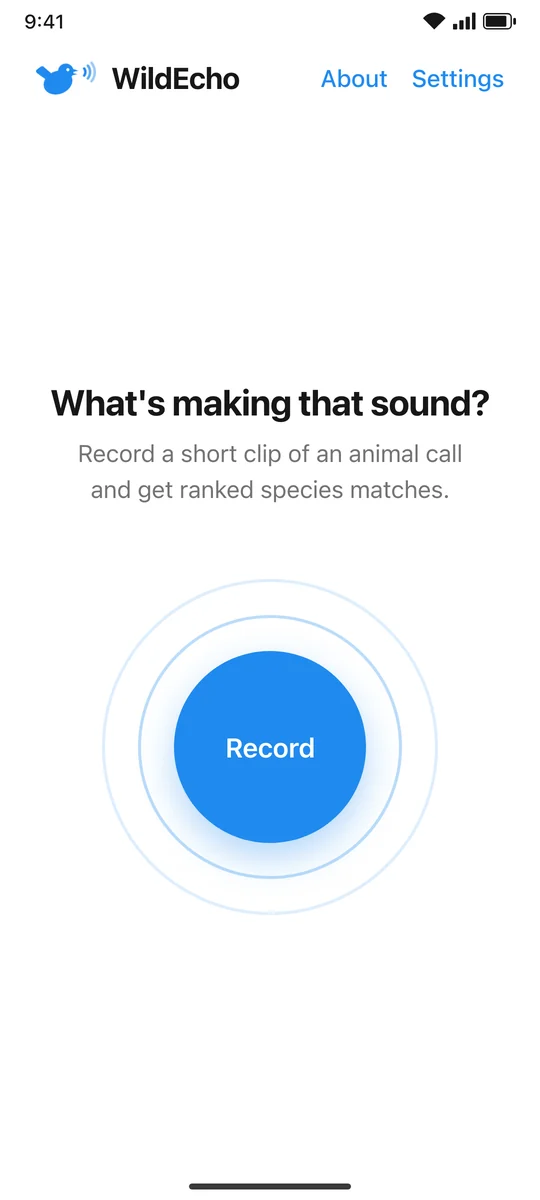
What's making that sound?
Record a few seconds of a bird, frog or insect. WildEcho listens and tells you which species it most likely is, with an honest confidence score.
FreeNo accountNo ads or trackingOpen source
No setup and no sign-up. Open the app and point your phone at the sound.
Tap the big button while the animal is calling. A few seconds is enough; WildEcho stops on its own at 25.
The clip is analysed by Perch 2.0, Google Research's open bioacoustics model trained on thousands of species.
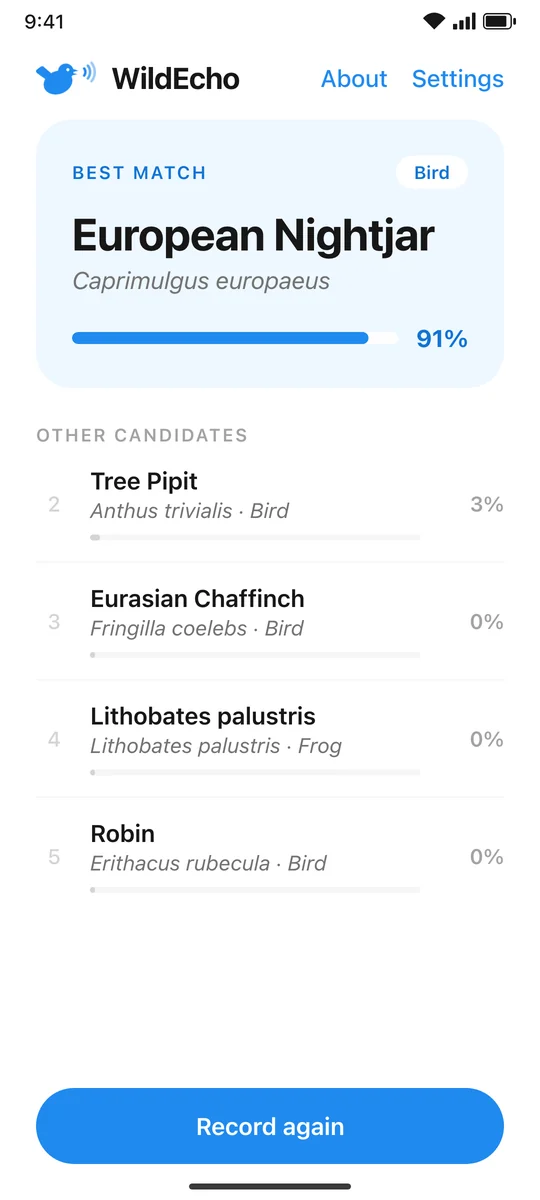
See the best match with its scientific name, plus other likely candidates, each with a confidence score.
Most ID apps show one confident name, even when they're guessing. WildEcho shows you how sure it is.
WildEcho was built to be the kind of app you'd recommend to a friend without a second thought.
No sign-up, no email, no login. Install and record.
No analytics or advertising SDKs, in the app or on this page.
Audio is analysed in memory to answer your request, then discarded.
Recordings travel over HTTPS to the identification server.
WildEcho is strongest on birds. About 70% of what the model knows are bird species. It also recognises many frogs, insects and mammals, but coverage there is thinner, so treat those results as leads to check rather than final answers.
Bats are not covered. Their echolocation calls are mostly ultrasonic, above what phone microphones and this model can hear.
You need an internet connection. Identification runs on a server because the model is far too large to fit on a phone.
The app and the identification server are MIT licensed. Run your own server and point the app at it in Settings, or call it from your own code.
Yes. There's no subscription, no in-app purchases and no ads. The public server is run by the developer, and the public API is rate limited to keep it fair for everyone.
For clear recordings of birds it's very good. Accuracy drops with background noise, distant calls and several animals calling at once, and it's lower for non-bird species. The confidence score tells you how much to trust each result.
No. Your clip is sent to the identification server, so you need a data or Wi-Fi connection.
Not yet. WildEcho is on Android first.
WildEcho is an independent open-source project by Arun Rajiah. It uses Perch 2.0 by Google Research, released under the Apache 2.0 licence. WildEcho is not affiliated with or endorsed by Google.